Canine Derotation with Clear Aligners: Possible or Predictable?
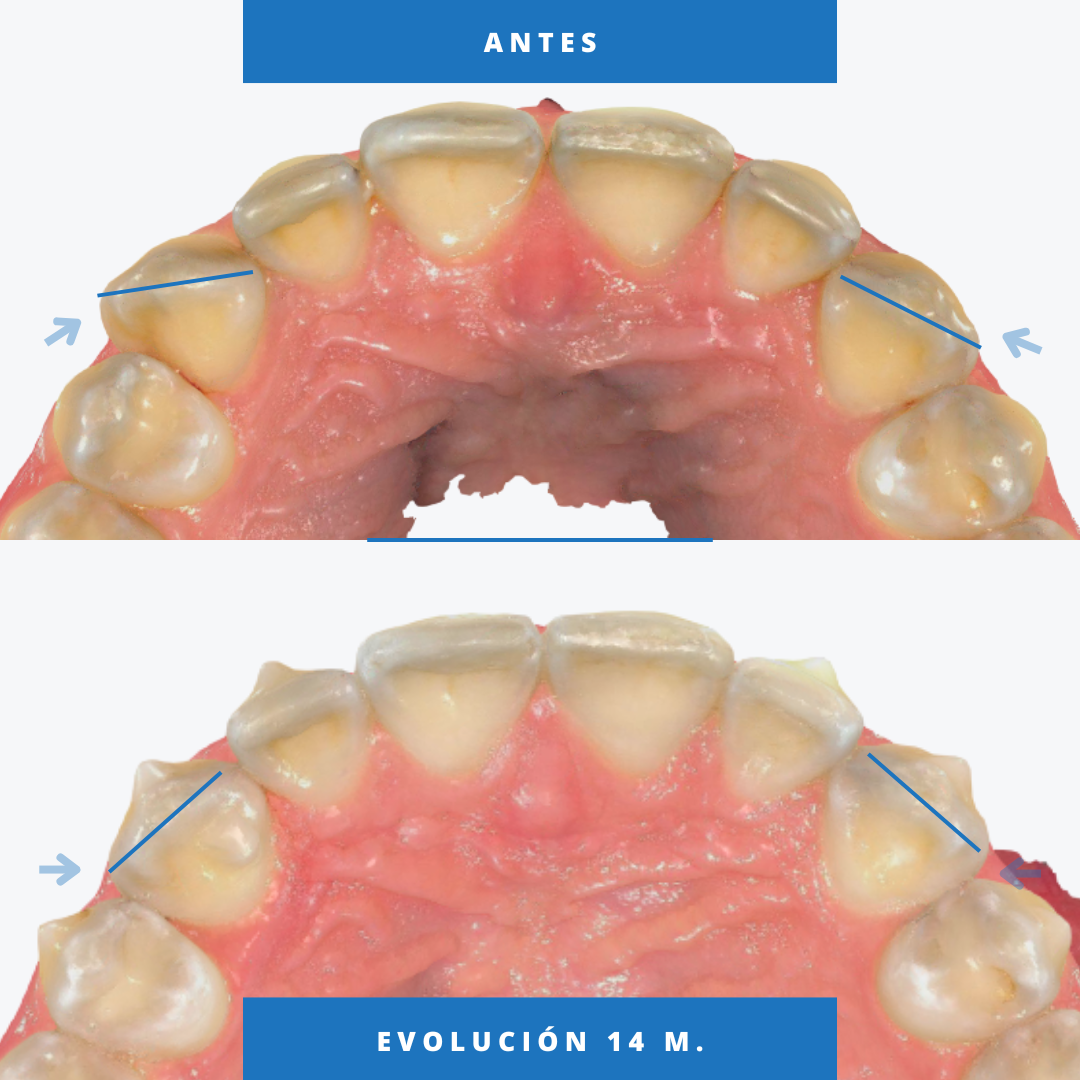
Can a severely rotated canine be corrected using clear aligners alone? In this clinical case, approximately 80% of the derotation was achieved after 14 months of treatment through progressive space creation, buccal and palatal attachments, controlled staging, and a hinge-rotation approach. This case demonstrates that a movement may be possible with clear aligners, although this does not necessarily mean that it is the fastest or most predictable treatment option.
Clinical context
The patient presented with a severely rotated maxillary canine and specifically requested treatment using clear aligners only. From the beginning, the patient was informed that canine derotation is a complex and potentially less predictable movement. Additional treatment time, a greater number of aligners, refinements, or the use of auxiliary mechanics could become necessary. The patient understood these limitations and decided to continue with the proposed aligner-based treatment. After one year and two months, approximately 80% of the planned derotation has been achieved. The case is currently still in progress.
Objectives
• Create adequate mesial and distal space before performing the main rotational movement. • Improve biomechanical control and maintain proper aligner tracking. • Perform the derotation through small, progressive, and controlled movements. • Preserve the arch form while reducing unwanted movements in adjacent teeth.
Digital planning
The digital treatment plan was divided into specific biomechanical objectives. The first stage focused on creating adequate space around the canine to reduce interproximal interference and allow the tooth to rotate more freely. The canine was then progressively derotated using a hinge-rotation approach rather than attempting a large, pure rotation around its long axis from the beginning. Buccal and palatal attachments were incorporated to increase the amount of aligner material engaging the tooth and to create force application points on opposite surfaces. The staging was intentionally slow and controlled, with the understanding that this approach would require a greater number of aligners.
Biomechanics
Canine derotation is challenging with clear aligners because of the rounded and convex anatomy of the canine crown. This morphology may limit aligner engagement and reduce the efficiency of rotational forces. Creating adequate space before initiating the main derotation was an essential part of the treatment strategy. When insufficient space is available, interproximal contacts may restrict the rotation. The tooth may behave as though it is becoming “screwed” or locked between the adjacent teeth rather than rotating freely. This may result in loss of tracking, unwanted tipping, vertical displacement, or incomplete expression of the planned movement. The buccal and palatal attachments increased the contact area between the aligner and the tooth. Their position on opposite surfaces was intended to improve rotational control and generate a force system closer to a couple. A simple analogy is a valve handle: applying forces at two separated points makes it easier to generate rotation than attempting to rotate the object from a single point. The treatment also incorporated a hinge-rotation approach. Rather than attempting to rotate the canine completely around its long axis in one movement, the correction was divided into smaller and more manageable stages. This strategy may improve control, but it generally requires more aligners and a longer treatment time.
Educational commentary
Can a canine be derotated using clear aligners alone? Yes, it may be possible in selected cases. However, this does not mean that aligners are always the most efficient or predictable option. In retrospect, once adequate space had been created, an auxiliary couple using two bonded buttons could have provided a more direct rotational force system and potentially reduced the number of aligners required. Clear aligners are one of many tools available in orthodontics. They should not become a limitation when a different biomechanical approach may be more efficient. Treatment mechanics should determine the appliance or auxiliary used, rather than allowing the appliance to determine the entire treatment strategy. At this stage, approximately 80% of the canine derotation has been achieved. I hope to complete the correction and share a final update of this case soon.