Second Molar Mesialization: Moving a Second Molar into a First Molar Position
What can we do when a first molar has a poor prognosis? In this case, the mandibular first molar was extracted and the second molar was mesialized into its position, while also taking advantage of the mesial migration of the distal molar. Space closure required approximately 15 months and involved skeletal anchorage with buccal and lingual biomechanical control.
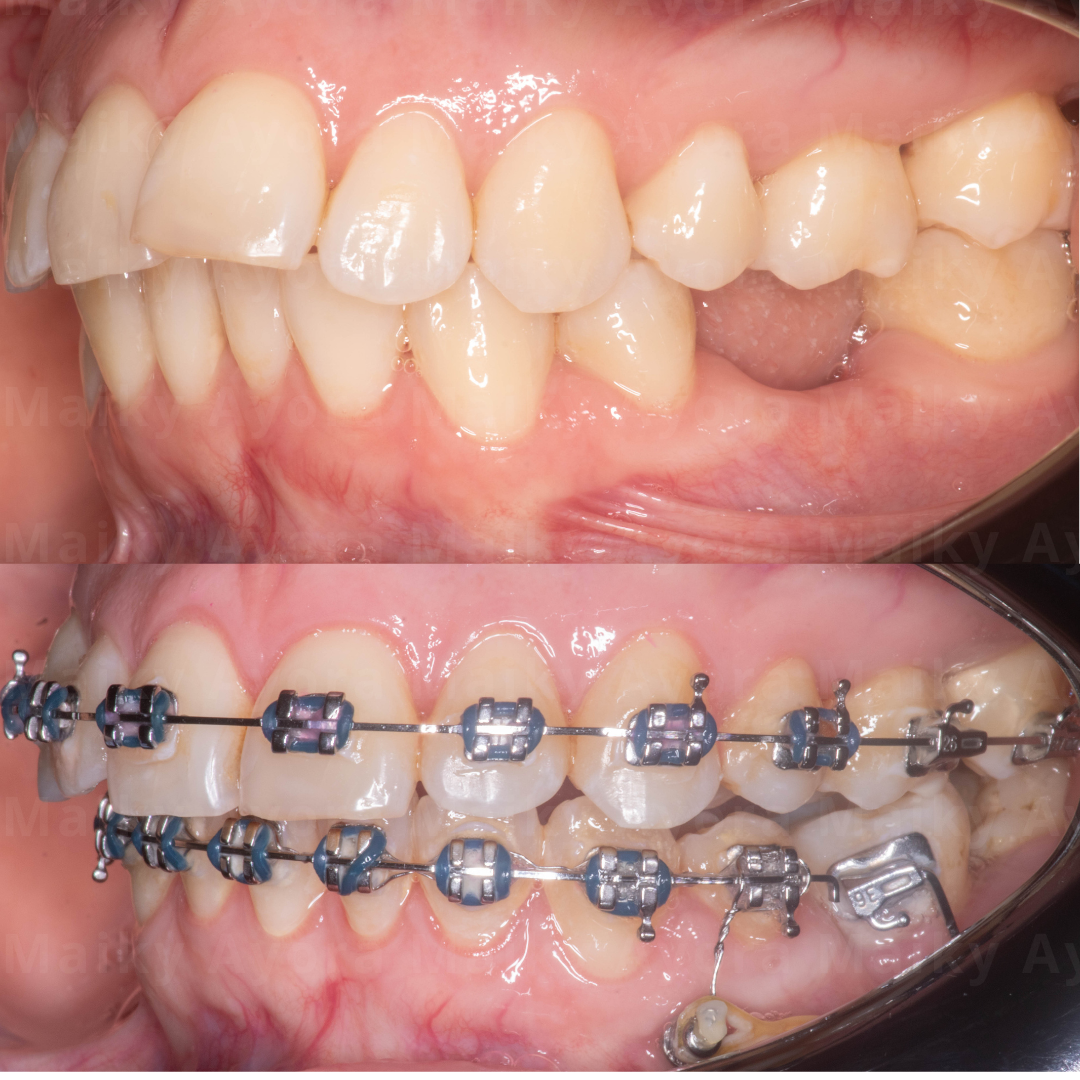
Clinical context
The patient presented with a previously endodontically treated first molar with a poor prognosis. After evaluating the available alternatives, the decision was made to extract the tooth and preserve the posterior teeth, planning the mesialization of the second molar into the first molar position. The objective was not only to close the space, but to do so while maintaining as much control as possible over molar tipping and rotation.
Objectives
Mesialize the second molar into the first molar position, close the extraction space, and achieve maximum possible control of tipping and rotation during movement.
Digital planning
A mechanics system using buccal and lingual skeletal anchorage was planned. A power arm was incorporated to modify the line of action of the force and favor a movement closer to bodily translation.
Biomechanics
Mesializing a molar is not a simple movement. When force is applied from a single point, there is a strong tendency to generate tipping and rotation instead of pure translation. For this reason, forces were applied from both the buccal and lingual aspects, aiming to improve three-dimensional control of the molar. Even when using mechanics designed to favor bodily movement, some degree of tipping and rotation appeared during treatment. This reminds us that biomechanics can help control and reduce unwanted effects, but cannot always eliminate them completely. The predictability of extensive molar mesialization depends on multiple variables: *Age and biological response. *Available bone quantity and quality. *Periodontal condition. *Force magnitude and direction. *Control of tipping and rotation. *Oral hygiene and patient cooperation.
Tools used
Fixed orthodontic appliances, buccal and lingual mini-implants, power arm, and molar mesialization mechanics with skeletal anchorage.
Educational commentary
One of the most interesting aspects of the case was observing that the tooth located distally also showed mesial migration, even without receiving direct active mechanics. We do not always need to control every tooth movement completely. In certain situations, allowing a tooth some freedom can help us take advantage of its physiological tendency to migrate mesially. This also demonstrates why no appliance should dictate our treatment plan. An aligner, for example, could restrict part of this spontaneous migration if we fully incorporate a tooth that we actually want to leave free to move.