Back to notesBiomechanics
Dental Biomech: Understanding Orthodontic Biomechanics in 3D
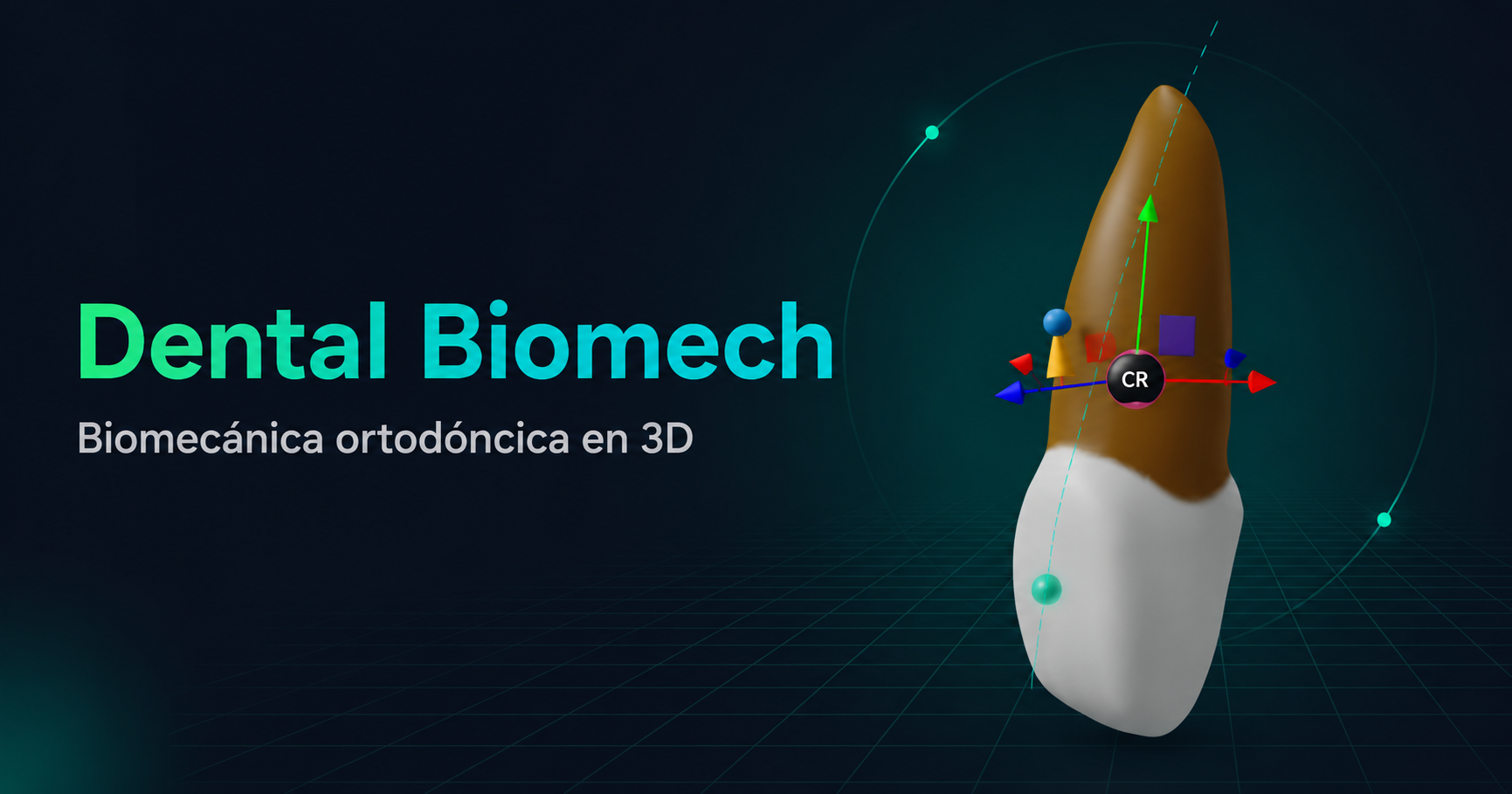
Dental Biomech is a free educational tool designed to help students, orthodontists, and educators understand orthodontic biomechanics in three dimensions. It provides an interactive way to visualize forces, moments, lines of action, centers of resistance, and other mechanical concepts that can be difficult to interpret using traditional two-dimensional diagrams.
August 24, 202616
What is Dental Biomech?
Biomechanics is a fundamental part of orthodontics, but understanding how a force produces a particular effect on a tooth or group of teeth can be challenging when these concepts are studied only through two-dimensional diagrams.
Dental Biomech was created as an educational tool to bring these concepts into an interactive three-dimensional environment.
Its purpose is not to replace the classical principles of orthodontic biomechanics, but to make them easier to understand by providing a visual representation of the force systems used in orthodontics.
What can we visualize?
Dental Biomech allows forces to be applied directly to three-dimensional dental models while different components of the mechanical system can be analyzed.
The platform includes visualization of:
Point of force application.
Force magnitude and direction.
Line of action.
Force decomposition along different spatial axes.
Moments generated by a force.
Directly applied moments.
Center of resistance.
Center of rotation.
Interaction between individual teeth or groups of teeth.
Concepts that are traditionally represented with arrows, angles, and diagrams can therefore be explored within a spatial environment where the mechanics can be modified interactively.
Who is Dental Biomech for?
Dental Biomech is primarily designed for:
Dental students who are beginning to study the principles of biomechanics.
Orthodontic residents and postgraduate students who want to connect biomechanical theory with different mechanical situations.
Orthodontists who want to explore or communicate biomechanical concepts.
Educators who can use three-dimensional models to explain forces, moments, and orthodontic force systems in a more visual way.
What is its educational value?
One of the main challenges when learning biomechanics is developing the ability to understand forces and moments in three dimensions.
Dental Biomech allows users to modify a force and immediately visualize its position, direction, line of action, and spatial components. This makes it easier to explore questions such as:
Where is the force being applied?
In which direction is it acting?
What is its relationship with the center of resistance?
What moment can this force generate?
What happens if the point of application is changed?
The goal is to transform abstract biomechanical concepts into elements that can be visualized, manipulated, and analyzed.
A tool for learning biomechanics
Dental Biomech should be considered an educational simulator. Real orthodontic tooth movement depends on numerous biological and mechanical variables; therefore, the software is not intended to predict exact clinical tooth movement or replace a complete biomechanical analysis.
Its purpose is different: to provide a space where students, educators, and clinicians can explore orthodontic biomechanics in three dimensions and develop a better understanding of the force systems used in everyday orthodontic practice.
Dental Biomech is completely free and can be accessed directly from your browser at dentalbiomech.com.